Mechanical and ballistic performance of multilayer aramid laminates with nanofiller-reinforced HDPE/LDPE films
DOI:
https://doi.org/10.18226/23185279.e261603Keywords:
nanofillers, nanocomposites, aramid fabric, ballistic protection, multilayer plate.Abstract
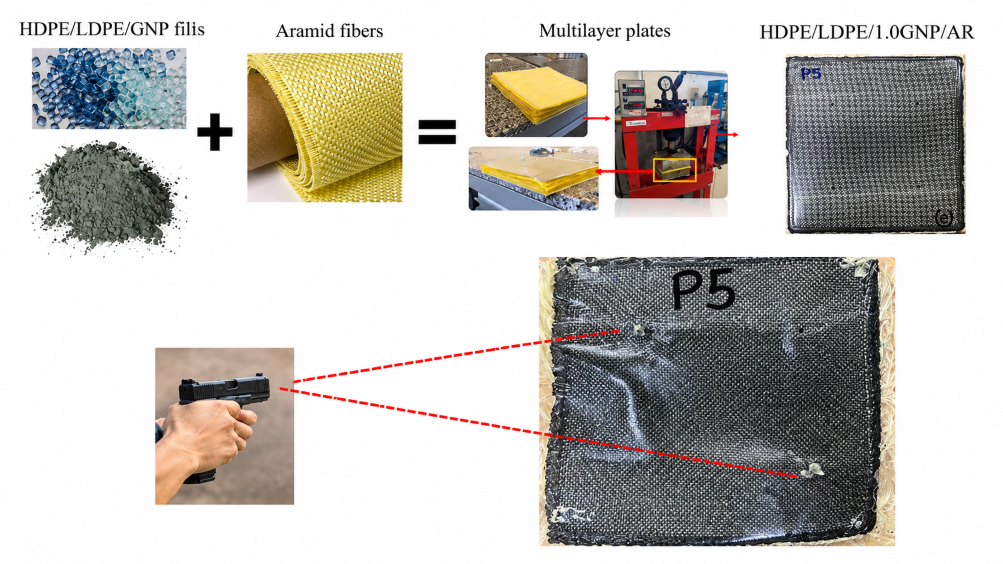
The increasing demand for lightweight and efficient ballistic protection systems has motivated polymer-based composites combining high impact resistance. In this study, nanostructured high-density polyethylene (HDPE) and low-density polyethylene (LDPE) films containing cellulose nanofibers (CNF), graphene nanoplatelets (GNP), or organoclay (CLAY), were produced by melt extrusion and combined with aramid fabric (AR) to manufacture multilayer composite plates through hot compression molding. The composites were characterized by Split Hopkinson Pressure Bar (SHPB) dynamic compression tests, ballistic impact tests following NIJ 0101.06 and NBR 15000 standards, backface deformation measurements, and tensile, flexural, and impact tests. Among the evaluated formulations, the composite containing 1.0 wt.% CNF exhibited the best overall mechanical performance under dynamic loading, showing higher stress, toughness, and energy absorption than the reference material. No plate was perforated and all backface deformations (22.2–29.1 mm) were below 44 mm, meeting the Level III-A criteria under the conditions adopted, although three formulations were impacted above the velocity tolerance (a more severe condition). The GNP and CLAY formulations exhibited the lowest backface deformation after ballistic impact, indicating enhanced energy dissipation. The results show that nanostructured HDPE/LDPE films reinforced with suitable nanofillers, particularly CNF, are promising for multilayer ballistic protection systems.
Downloads
Additional Files
Published
How to Cite
Issue
Section
License
Copyright (c) 2026 Daniele Dalle, Lídia Kunz Lazzari, Cleide Borsoi, Heitor Ornaghi Junior, LILIAN ROSSA BELTRAMI, ADEMIR JOSÉ ZATTERA

This work is licensed under a Creative Commons Attribution 4.0 International License.
Declaração de originalidade e cessão de direitos autorais
Declaro que o presente artigo é original, não está sendo tendo sido submetido à publicação em qualquer outro periódico nacional ou internacional durante o processo de revisão. Através deste instrumento, em meu nome e em nome dos demais co-autores, porventura existentes, cedo os direitos autorais do referido artigo à revista SCIENTIA CUM INDUSTRIA. Contudo, a reprodução total ou parcial impressa ou eletrônica pode ser feita desde que o autor comunique oficialmente à revista. Declaro estar ciente de que a não observância deste compromisso submeterá o infrator a sanções e penas previstas na Lei de Proteção de Direitos Autorias. Declaro estar ciente de que a não observância deste compromisso submeterá o infrator a sanções e penas previstas na Lei de Proteção de Direitos Autorias (Nº9610, de 19/02/1998).